

Y2K38: the year 2038 bug is already a planning problem
One second beyond the limit can invalidate dates in legacy systems. Here is where the risk appears, what Linux projects have changed, and how to prepare software, equipment and contracts.
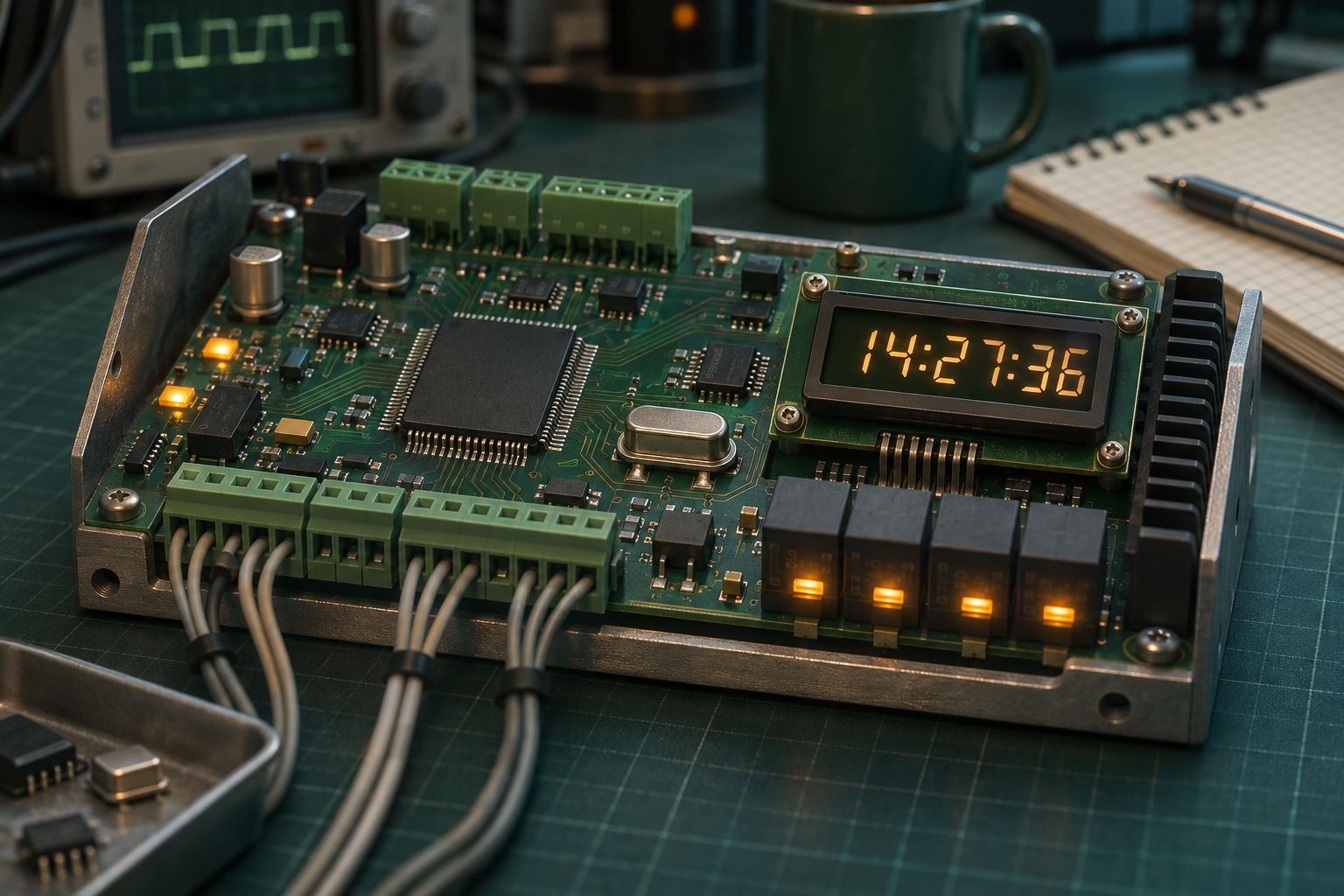
A maintenance system scheduling an inspection for 2040 can run into Y2K38 today. If an integration still keeps the date in a signed 32-bit Unix counter, it may reject the date, truncate it or interpret it as a date in the past. The risk appears whenever a system handles dates beyond the limit, even before its own clock reaches it.
What happens on January 19, 2038
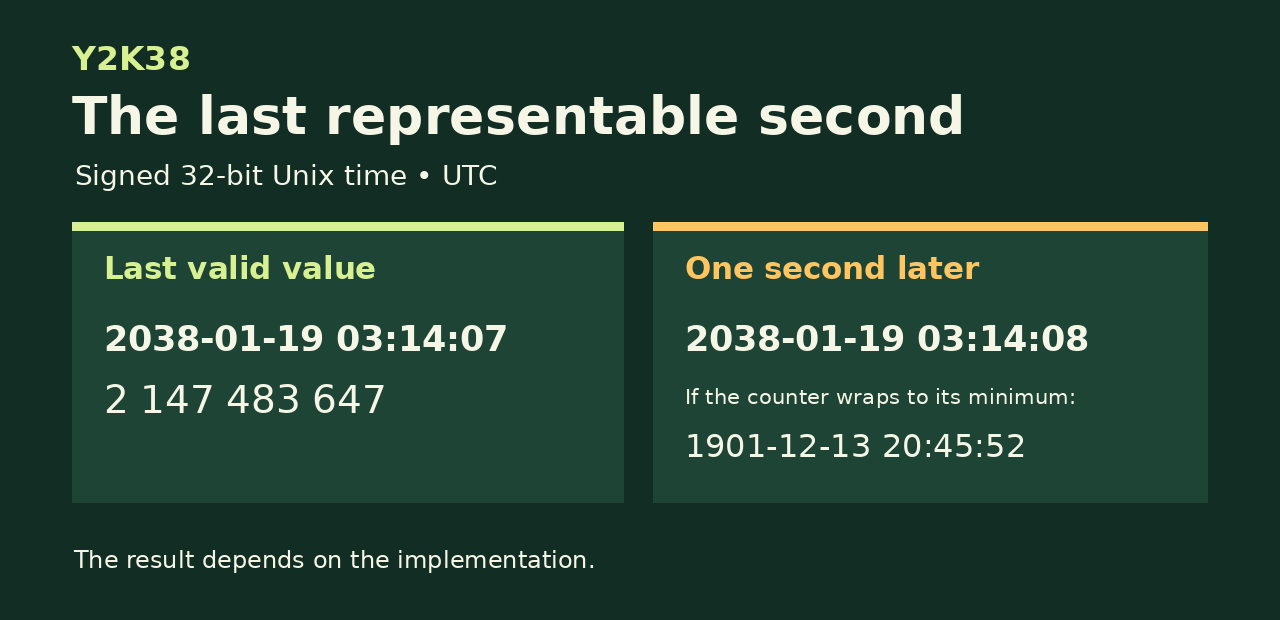
Unix time is typically expressed in seconds since January 1, 1970 at 00:00:00 UTC. A signed 32-bit integer can hold at most 2,147,483,647. That value corresponds to January 19, 2038 at 03:14:07 UTC. The next second requires 2,147,483,648, which is outside the range.
If the bits are interpreted as the most negative value, the apparent date becomes December 13, 1901 at 20:45:52 UTC. The result depends on the implementation. One system may reject the date or stop an operation. Another may accept the wrong value and continue running, making the effects harder to detect.
Where the impact could appear
Long-lived industrial equipment deserves attention. CERT@VDE documented the issue for specific WAGO models. Its advisory describes functions that may fail during operation or after a restart and points to updated firmware for the affected models. This is a documented product-level example. It gives no count of exposed devices in Brazil or elsewhere.
Referência: CERT@VDE — WAGO's year 2038 advisory and firmware remediation
In business software, follow the date across application boundaries. An ERP may store 2040 correctly and then send the due date to a connector that uses a 32-bit field. Contracts, installment payments, certificate renewals, maintenance schedules and audit trails are all worth checking. The damage could be a rejected transaction, a job running at the wrong time or a record that differs across systems.
| Layer | Where to look | Evidence of a fix |
|---|---|---|
| Software and libraries | Date conversions, native libraries, older binaries | Automated tests before and after the boundary |
| Data and integrations | Database columns, files, messages and partner APIs | The date survives a round trip without loss |
| Equipment | Firmware, clocks and supervisory systems | Bench test on the version scheduled for deployment |
What is already being done
Debian 13 adopted a 64-bit time application binary interface on every architecture except i386. On armel and armhf, third-party programs and related libraries may need to be rebuilt together. The GNU C Library documents how to request a 64-bit time_t where supported. Updating the operating system helps. A deliberately 32-bit database column, file field or protocol value retains its own limit.
Referência: Debian 13 — official release notes on the transition to 64-bit time_t
Referência: GNU C Library — _TIME_BITS and _FILE_OFFSET_BITS feature macros
In January 2026, openSUSE reported that moving the clock forward in build environments uncovered failures across several packages, some of which had already been corrected. The International Telecommunication Union published a technical paper on coordination, testing and procurement for time rollover events. It discusses asking suppliers for evidence about long-lived systems.
Referência: openSUSE News — Y2K38 testing and fixes
Referência: ITU — technical paper on coordinating time rollover events
What to do now
1. Inventory the systems. Record ownership, expected service life, supported versions and where dates enter and leave each component. Prioritize critical systems, equipment that is difficult to replace and workflows that already accept dates beyond 2038.
2. Test the complete workflow in an isolated test environment or on a bench. Exercise one second before the limit, the limit itself, one second after it and realistic business dates such as a contract expiring in 2040. Test reads and writes, restarts, queues and backup recovery. Check that invalid dates are rejected clearly, without changing production clocks.
3. Plan updates, migrations or replacements. Use time types or 64-bit representations suited to the domain. Migrate data and version interchange formats with partners where necessary. Ask suppliers which models and versions they cover, how to update them and what they tested. For critical equipment, validate recovery before rollout.
The decisive test is easy to explain. A date beyond the limit must enter through a real workflow, reach every destination intact and remain correct after a restart or recovery. That is stronger evidence than the server's CPU architecture alone.
Video — the end-of-time bug
News coverage in Brazil and abroad
Referência: Tecnoblog (Brazil) — Debian takes steps against the 2038 bug
Referência: Canaltech (Brazil) — the next millennium-style bug
Referência: Neowin (international) — coverage of Debian’s 64-bit time transition
Referência: Axios (international) — how unusual dates affect computer systems
Comments
There are no approved comments yet.
Sign in to comment